It's been an obscenely time since I wrote here, but I'll defend myself by saying there's been a few big changes in my life.
I'm no longer with Streamline Studios, and moved back to Portugal and sunny Lisbon (but definitely a bit chilly these days). I've stepped on board the good ship GameInvest as lead game designer, and it's being a blast as well as a huge challenge. Getting caught up with ongoing projects is never easy, even when you get back from vacations, but it's always a rush. Got a lot of thinking, planning and prioritizing to do, and this time not just for myself and others on occasion, but as a full time lead for my 3 awesome design guys. But all the geeky kidult joy of game dev is right there to bond us, and I'm already feeling a part of the gang. Beijinhos e abraços pessoal, se estiverem a ler (!).
I'll write something soon, I promise, when I get some time. Maybe about my World of Warcraft wanderings, the looting and XP gaining love I'm getting from Torchlight and Borderlands, or how I'm seeing such parallels between my beloved old school graphic adventures (thanks again Lucas and Sierra) and the casual games of today. Or maybe I'll finally give Love (the game, if you know me you know I can't help the emotion) a try and talk about h4x0rzing frequencies in an impressionist painting feels.
game on
Tuesday, December 15, 2009


Sunday, October 4, 2009
Brütal Legend Demo Impressions
The Brütal Legend just came out for us Europeans last Thursday, and I thought I'd write down some of my first impressions.

Right from the start, you can tell this is a Tim Schafer/Double Fine game - once again, the charismatic protagonist is thrown into a strange world and with good-spirited determination steps into the unknown; there's the subtle social humour, never forced and always genuinue; the humour - one of my favorite lines in Psychonauts, Coach Oleander taunts Raz: "You're slower than molasses crawling up a hill... in January!" and in BL Eddie was taunting the worm boss: "It smells like a whale... ate a bunch of tuna... and died in your mouth... like a YEAR ago!"
The intro is delivered brilliantly, I can't imagine any rock or metal fan not immediately bonding with Eddie when those obnoxious kids play, and, well, what happens next is really one of the most bad-ass death and delivery scenes I've enjoyed in games, and sets you right down into gameplay at the end, an artful trick I've loved since I first saw it in FFVII. And the whole damn thing is fucking Metal, to the core. In that respect, it's already a success in my mind, since it completely lives up to its vision (during those first crucial moments in the demo, of course - but knowing the people behind it, this will carry through the rest of the game).
Most of the demo is really dedicated to introducing you, magnificently, to the Brütal Legend universe, its story, characters and mood. You do get a great blast of the gameplay, so sweet but over so quickly. Firstly, I'd just like to make one thing clear: calling the battle axe THE SEPARATOR is inspired. That's metal, and it's the kind of bad-assery that puts a constant smile on your face throughout the game. So, back to gameplay: Psychonauts was naturally Tim's closest experience to this type of gameplay, since the graphic adventures felt very different. BL still retains that simplicity: you have controls for your axe and axe (battle and guitar), and by tapping, holding or pressing A and X together (X360 version), you pull off melee and magic attacks, and an amazing earth-shaking area effect power chord attack. Oh - you bring the house down with it. Yes, literally.
No jump, trigger lock-on - it's a 3rd person action adventure, and the respect for the traditions laid down by games like Zelda - the lock-on simple fighting, the amazing ride on the Deuce AKA DRUID PLOW (*making metal horns with hand*), the three-stage boss fight - and some innovations from things like Fable's slow-mo cinematic deaths with these 2 button combos, and wraps it all together with the humor we know and love, from the chatter (I won't go into how awesome Jack Black is, you should know this by now) to every detail in the setting, like flying worm beasts and comet rain in the sky.
I also wanted to point out the excellent art style and particularly the character art and animations - incredibly expressive faces and tight lip-syncing really bring them to life, and it's a merit to both the talented artists at Double Fine and also the brilliantly conceived, caricatured and painted art style.
I think it's obvious by now I'm getting this for sure - but I also think this game will be great for us. There's never enough good humor in games - and even fewer games can deliver that uncompromising, bad-ass and forward moving action experience while still retaining such a heart, and such a roaring funny time. And the fact that it's a MetroidZeldavania set-up, with a massive world that you can explore further with enhanced abilities, well, that's one of my gaming nirvanas, and one of the must intuitive and immersive high level structures possible, in my mind. Learn more, do more, go further. Feels right.
Oh, I forgot to mention the music. Well, that's because I was too busy banging my head listening to it. Go here for a reminder of how great this soundtrack is.
So I guess, bottom line: if you like this type of 3rd person action adventure games (Zelda, Fable, Ratchet, Jak, Beyond Good and Evil), Metal, funny and character driven stories in crazy worlds, I think you'll love Brütal Legend. There's also light RTS in multiplayer, so that ought to add some wider appeal for strategy fans. Maybe not for everyone - it doesn't try to be the mega-everything-genre game, for example I don't see realism lovers digging it if they don't get into the story or music.
But I think it's already becoming clear - if the demo's feeling carries through the whole game, we've got another Schafer masterpiece. I'm happy, and waiting for Rocktober 16th (yes... delayed 3 days).
Rock on!
Right from the start, you can tell this is a Tim Schafer/Double Fine game - once again, the charismatic protagonist is thrown into a strange world and with good-spirited determination steps into the unknown; there's the subtle social humour, never forced and always genuinue; the humour - one of my favorite lines in Psychonauts, Coach Oleander taunts Raz: "You're slower than molasses crawling up a hill... in January!" and in BL Eddie was taunting the worm boss: "It smells like a whale... ate a bunch of tuna... and died in your mouth... like a YEAR ago!"
The intro is delivered brilliantly, I can't imagine any rock or metal fan not immediately bonding with Eddie when those obnoxious kids play, and, well, what happens next is really one of the most bad-ass death and delivery scenes I've enjoyed in games, and sets you right down into gameplay at the end, an artful trick I've loved since I first saw it in FFVII. And the whole damn thing is fucking Metal, to the core. In that respect, it's already a success in my mind, since it completely lives up to its vision (during those first crucial moments in the demo, of course - but knowing the people behind it, this will carry through the rest of the game).
Most of the demo is really dedicated to introducing you, magnificently, to the Brütal Legend universe, its story, characters and mood. You do get a great blast of the gameplay, so sweet but over so quickly. Firstly, I'd just like to make one thing clear: calling the battle axe THE SEPARATOR is inspired. That's metal, and it's the kind of bad-assery that puts a constant smile on your face throughout the game. So, back to gameplay: Psychonauts was naturally Tim's closest experience to this type of gameplay, since the graphic adventures felt very different. BL still retains that simplicity: you have controls for your axe and axe (battle and guitar), and by tapping, holding or pressing A and X together (X360 version), you pull off melee and magic attacks, and an amazing earth-shaking area effect power chord attack. Oh - you bring the house down with it. Yes, literally.
No jump, trigger lock-on - it's a 3rd person action adventure, and the respect for the traditions laid down by games like Zelda - the lock-on simple fighting, the amazing ride on the Deuce AKA DRUID PLOW (*making metal horns with hand*), the three-stage boss fight - and some innovations from things like Fable's slow-mo cinematic deaths with these 2 button combos, and wraps it all together with the humor we know and love, from the chatter (I won't go into how awesome Jack Black is, you should know this by now) to every detail in the setting, like flying worm beasts and comet rain in the sky.
I also wanted to point out the excellent art style and particularly the character art and animations - incredibly expressive faces and tight lip-syncing really bring them to life, and it's a merit to both the talented artists at Double Fine and also the brilliantly conceived, caricatured and painted art style.
I think it's obvious by now I'm getting this for sure - but I also think this game will be great for us. There's never enough good humor in games - and even fewer games can deliver that uncompromising, bad-ass and forward moving action experience while still retaining such a heart, and such a roaring funny time. And the fact that it's a MetroidZeldavania set-up, with a massive world that you can explore further with enhanced abilities, well, that's one of my gaming nirvanas, and one of the must intuitive and immersive high level structures possible, in my mind. Learn more, do more, go further. Feels right.
Oh, I forgot to mention the music. Well, that's because I was too busy banging my head listening to it. Go here for a reminder of how great this soundtrack is.
So I guess, bottom line: if you like this type of 3rd person action adventure games (Zelda, Fable, Ratchet, Jak, Beyond Good and Evil), Metal, funny and character driven stories in crazy worlds, I think you'll love Brütal Legend. There's also light RTS in multiplayer, so that ought to add some wider appeal for strategy fans. Maybe not for everyone - it doesn't try to be the mega-everything-genre game, for example I don't see realism lovers digging it if they don't get into the story or music.
But I think it's already becoming clear - if the demo's feeling carries through the whole game, we've got another Schafer masterpiece. I'm happy, and waiting for Rocktober 16th (yes... delayed 3 days).
Rock on!
Saturday, September 19, 2009
Scribblin' around - Interconnected toolsets and playing while falling asleep
Certain games have the addictive quality of influencing your thoughts when you're not even playing them. Scribblenauts does this amazingly; having begun to play it, I've often been falling asleep, shaving in the morning, or doing any other mundane thing while running through problematic levels in my mind, trying different options. Sometimes I listen to a song and hear a noun that I think can be useful in the game, or think of using an object I walk by in real life.
There are two elements at play here I think: first, of course, the unique innovation in Scribblenauts, the ability to call up vast amounts of objects, and honestly - it's easier to be surprised by what it has than to stump it. But there's also something else, the fact that your tool-set is so clear and intuitive. The logic governing the AI is quite simple, pretty much [object] - fears/consumes/attacks/protects/follows/steals - [object]. Then there are a few other simple interactions like climb, ride, shoot, use and the ability to fly. Thanks to the brilliant hierarchical Objectnaut engine, the 5th Cell team was able to efficiently populate and interlink all these objects and actors so that adding a vampire could be as simple as adding a humanoid, giving it some art, flight, aggression towards all and fear of garlic. For instance.
Now, an immediate counterpoint to what I just said is that such an approach decreases the uniqueness and depth of individual elements, since they are all merely different combinations of the same base components. Well, that's true. Of course programming and animating unique jumps for each of your animal races will be more flashy than using the same jump logic/animation on different rigs. But while this approach can provide a very polished experience, detailed and expressive, I think its also a conscious choice to guide the player, rather than offer them freedom. A fine option, but for the point I'm making I want to focus on the latter option, creative choice, and consequent emergence.
I touched on emergence in my previous article about trigger-whoa mechanics and interacting with systems like physics and AI. Returning to Scribblenauts, there's a lot of that going on. A passable physics engine ensures things fall and roll well enough, and the aforementioned AI rules can cause real chaos when you fill the screen with living things. On top of all this, there's your vast amount of choice, and that's the kicker: for any given scenario, I'd wager there are objects that you can write which would interact with each and every different parameter of your situation.
And that's the core, really - the fact that everything is interconnected. Bad game design will leave loose ends, cool but one-off mechanics, unbalanced events requiring more fuel than exists, things like that. Good design brings it all together, makes the tokens you want advance your progression, enabling you to fuel your abilities and expand them to get more tokens and repeat the cycle, and so on. It's about creating positive feedback loops, and never letting the player down through frustrating inability on the game's part to deliver.
This isn't anything new, just basic game design. It's easily forgotten though, especially as you make a game bigger an deeper. Which is understandable, really - the more systems, bits and pieces you've got in your game, the harder it is to make them interlock neatly. What happens when the cool fire gun is perfect for gameplay with its spread and damage over time but the ability to set things on fire in any realistic way would break the balance completely in your realistic ice world? Ok, so make "magic purple non-fire". Sure, but then what's your ammo? Can't be oil or anything realistic, so what?
See my point? You either accept just the enemy burns but nothing else, or that the fire becomes overpowered, or that you make immersion a little harder by breaking realism. So admittedly, my example is somewhat exaggerated, and I can think of a few options around it, but that's the essence of it - the fact that the more there is, the more you need to piece together.
So I think this makes a strong case for the type of design and development approach that aims low with the system count and high with the options to interact with it. Physics and simple predator/prey dynamics, with tons of physics and manipulation abilities, or AI and motion control, with lots of interesting ways to influence AI with your gestures. And these are those games that, like I was saying, keep you running their options. RTS games can do this a lot, although they have become increasingly complex in their number of subsystems, and therefore harder to simulate in your mind. Other games that share ideas with Scribblenauts like Little Big Planet, Crayon Physics with their editors (software and drawing) and variety of choices to interact with simple physics. More traditional block and maze type puzzle games, of course, but those can often get boring to think about with their typical handful of ways to interact - more fun to play.
The converse of this is of course the linear mega-game with every kind of system and gameplay in it, giving you key moments and very specific ways of interacting with things. Very often these games will have far too many systems, too much happening too fast, for you to even hope to simulate them mentally. Bioshock comes to mind as an exception, a game with an eco-system that you understood somewhat once you learned it, and became able to manipulate quite well. I at least relished my convoluted traps for those Big Daddies and Splicers, exploiting both their alliances and animosities as well as their various weaknesses, but I thought on my feet, as events happened. Planning skating runs in Tony Hawk as well, for example, or running through well-practiced tracks in Burnout with all its shortcuts. For those latter examples, I think the depth of your interactions (from speed to tricks and drifting) counts as a strong diversity of ways to interact with the few game systems at play.
One particular development implication that comes to mind is that diverse and balanced interactions can often require more pre-production in the underlying infra-structure than the more immediate one-off counterparts - these can just be built sort of in order. One option has the risk of forcing you to spend too much time and effort before you've even got a product and with the other you may end up with a product that's a bloated chain of disconnected elements; so it's not like there's a better one. But I do think, like everything in life, that projects that that longer to really start are always less appealing than those that throw you right in.
And above all, I commend those people who would try something new, something that at first glance may be brushed off as too expensive/difficult, too simple or without enough blockbuster value. Those that try to build something new, and focus on richness and depth, rather than size and breadth. It's a lesson I've tried to incorporate in all my designs, no matter how commercial, that principle of balanced interconnected dynamics rather than lists of moves/events, and hope to see more of in the future. The empowerment of the player, the ability to make them feel, well, godlike, while playing will always be of the finest goals in game design, because with empowerment comes the ability for great challenge, and the ability to overcome this can lead to inner strength, confidence and self-improvement.
And I mean, really: what other game allows you to summon up God, the Devil and Death, tame a dragon with Cupid's arrow and ride it, wearing a full set of armor and lance, to attack the Grim Reaper himself? Oh, and Longcat along with alter-ego Tacgnol. :D
There are two elements at play here I think: first, of course, the unique innovation in Scribblenauts, the ability to call up vast amounts of objects, and honestly - it's easier to be surprised by what it has than to stump it. But there's also something else, the fact that your tool-set is so clear and intuitive. The logic governing the AI is quite simple, pretty much [object] - fears/consumes/attacks/protects/follows/steals - [object]. Then there are a few other simple interactions like climb, ride, shoot, use and the ability to fly. Thanks to the brilliant hierarchical Objectnaut engine, the 5th Cell team was able to efficiently populate and interlink all these objects and actors so that adding a vampire could be as simple as adding a humanoid, giving it some art, flight, aggression towards all and fear of garlic. For instance.
Now, an immediate counterpoint to what I just said is that such an approach decreases the uniqueness and depth of individual elements, since they are all merely different combinations of the same base components. Well, that's true. Of course programming and animating unique jumps for each of your animal races will be more flashy than using the same jump logic/animation on different rigs. But while this approach can provide a very polished experience, detailed and expressive, I think its also a conscious choice to guide the player, rather than offer them freedom. A fine option, but for the point I'm making I want to focus on the latter option, creative choice, and consequent emergence.
I touched on emergence in my previous article about trigger-whoa mechanics and interacting with systems like physics and AI. Returning to Scribblenauts, there's a lot of that going on. A passable physics engine ensures things fall and roll well enough, and the aforementioned AI rules can cause real chaos when you fill the screen with living things. On top of all this, there's your vast amount of choice, and that's the kicker: for any given scenario, I'd wager there are objects that you can write which would interact with each and every different parameter of your situation.
And that's the core, really - the fact that everything is interconnected. Bad game design will leave loose ends, cool but one-off mechanics, unbalanced events requiring more fuel than exists, things like that. Good design brings it all together, makes the tokens you want advance your progression, enabling you to fuel your abilities and expand them to get more tokens and repeat the cycle, and so on. It's about creating positive feedback loops, and never letting the player down through frustrating inability on the game's part to deliver.
This isn't anything new, just basic game design. It's easily forgotten though, especially as you make a game bigger an deeper. Which is understandable, really - the more systems, bits and pieces you've got in your game, the harder it is to make them interlock neatly. What happens when the cool fire gun is perfect for gameplay with its spread and damage over time but the ability to set things on fire in any realistic way would break the balance completely in your realistic ice world? Ok, so make "magic purple non-fire". Sure, but then what's your ammo? Can't be oil or anything realistic, so what?
See my point? You either accept just the enemy burns but nothing else, or that the fire becomes overpowered, or that you make immersion a little harder by breaking realism. So admittedly, my example is somewhat exaggerated, and I can think of a few options around it, but that's the essence of it - the fact that the more there is, the more you need to piece together.
So I think this makes a strong case for the type of design and development approach that aims low with the system count and high with the options to interact with it. Physics and simple predator/prey dynamics, with tons of physics and manipulation abilities, or AI and motion control, with lots of interesting ways to influence AI with your gestures. And these are those games that, like I was saying, keep you running their options. RTS games can do this a lot, although they have become increasingly complex in their number of subsystems, and therefore harder to simulate in your mind. Other games that share ideas with Scribblenauts like Little Big Planet, Crayon Physics with their editors (software and drawing) and variety of choices to interact with simple physics. More traditional block and maze type puzzle games, of course, but those can often get boring to think about with their typical handful of ways to interact - more fun to play.
The converse of this is of course the linear mega-game with every kind of system and gameplay in it, giving you key moments and very specific ways of interacting with things. Very often these games will have far too many systems, too much happening too fast, for you to even hope to simulate them mentally. Bioshock comes to mind as an exception, a game with an eco-system that you understood somewhat once you learned it, and became able to manipulate quite well. I at least relished my convoluted traps for those Big Daddies and Splicers, exploiting both their alliances and animosities as well as their various weaknesses, but I thought on my feet, as events happened. Planning skating runs in Tony Hawk as well, for example, or running through well-practiced tracks in Burnout with all its shortcuts. For those latter examples, I think the depth of your interactions (from speed to tricks and drifting) counts as a strong diversity of ways to interact with the few game systems at play.
One particular development implication that comes to mind is that diverse and balanced interactions can often require more pre-production in the underlying infra-structure than the more immediate one-off counterparts - these can just be built sort of in order. One option has the risk of forcing you to spend too much time and effort before you've even got a product and with the other you may end up with a product that's a bloated chain of disconnected elements; so it's not like there's a better one. But I do think, like everything in life, that projects that that longer to really start are always less appealing than those that throw you right in.
And above all, I commend those people who would try something new, something that at first glance may be brushed off as too expensive/difficult, too simple or without enough blockbuster value. Those that try to build something new, and focus on richness and depth, rather than size and breadth. It's a lesson I've tried to incorporate in all my designs, no matter how commercial, that principle of balanced interconnected dynamics rather than lists of moves/events, and hope to see more of in the future. The empowerment of the player, the ability to make them feel, well, godlike, while playing will always be of the finest goals in game design, because with empowerment comes the ability for great challenge, and the ability to overcome this can lead to inner strength, confidence and self-improvement.
And I mean, really: what other game allows you to summon up God, the Devil and Death, tame a dragon with Cupid's arrow and ride it, wearing a full set of armor and lance, to attack the Grim Reaper himself? Oh, and Longcat along with alter-ego Tacgnol. :D
Sunday, September 6, 2009
1.5 Player Games - Bonding with AI
Humans beings are social by nature, so much so that isolation from any living thing can lead to insanity. Even if we don't have other people around, we keep pets, bond and share experiences with them. I think we recognize and bond with sentient beings faster than anything else because that's absolutely the best approach for survival - it was co-operative survival that motivated single function amoebas to partner up and create multi-cellular organisms, after all.
In games though, until more or less recently, you've been playing alone. Like always, I think you can trace much of this limitation to lacking technology: limited AI resources, processing power for complex patterns, memory budget for additional avatar-level of detail entities, etc. There were some clever solutions taken over these years, however, to bypass these hurdles. Navi, your guiding fairy in Zelda games, comes to mind, particularly once the series moved to 3D with (masterpiece) Ocarina of Time.
Navi is a fairy that floats around you as Link in the Zelda games. She's a very smart little piece of game and character design, too. She:
- Points out your main objective, keeping you on track and adding atmosphere with a little comment (no abstracted mission arrow or the like bringing you out of the immersion)
- Highlights objects of interest in the environment (again eschewing abstractions like twinkles and indicators)
- Makes chatter with you and others (advances the story and creates mood)
- Talks about and remembers Link's solitary quests (allowing the story to have a mute protagonist going on adventures but still providing a way to communicate these experiences within the logic of the world)
- Is a small, shining white glow with beating wings (was cheap in terms of memory, requires no animation/rigging,)
- Has no independent AI, responding only to contextual environmental prompts and scripted events.
Navi is one of the earliest game companion experiences that I remember stuck with me. Simple though her behavior was, it was plausible enough that she would fly over to doors, switches and items when I approached them. I giggled at some of her comments, and was thankful she was able to mention my exploits for me. She was always there as I rode through Hyrule on Epona (another lesser, but still great companion - transport with personality) or on foot. She reminded me of everything that was going on, a living piece of the story traveling with me. The fact that I can't help attributing life and using a female pronoun only underscores how effective the immersion was.
I remember a fantastic journey with HK-47, the blood thirsty droid team-mate in BioWare's excellent Knights of the Old Republic. Having chosen the dark side (and I have yet to replay that as light side), I was slaughtering left or right, shooting and slicing before asking questions. And HK-47 was there all the time, giggling as only a droid can and getting way too excited over spilling blood. And remember, this was a game championing the element of player choice, offering the power to choose your own story arc into the light or dark side (or somewhere in between). HK was a wonderful reinforcement of all the choices I had made in my evil Sith persona, and an incredible contribution to the feeling that I was truly taking actions that affected my world (and not just going down an option tree). I remember saving and then re-loading a couple of times to make some light side choices, and HK was there, fittingly disapproving at my meaty, flesh-bag merciful tendencies. He made me feel guilty (I kid you not!) for betraying the darkness, and I hurriedly re-loaded, back to the safety of my unflinching brutality.
The Fable series has also tried very notably to offer the player choice and a sense of consequence in the world, right down to the cheering or jeering of townspeople as you walk by. Fable II famously introduced the Dog. Your pet. Loyal to the end, no matter how you treat it. A direct reflection of your personality as it runs around, independent. Tender and playful, or vicious and mean. Visually evolving to reflect your growth also. But it was more than a story element. Bringing all the companionship of constant presence while wandering, it was also alive, sometimes running off on its own accord, getting into fights, playing. It came to you when it got hurt, and (in my good playthrough) reveled when you gave it attention. It was also an aid in gameplay, fighting (with evolving skills like you), digging for items; it made a single-player game feel like a fantasy journey with a real canine companion. And the opportunity was definitely not missed to use your attachment to the dog in the story development, forcing some heart-wrenching moments and choices.
Atlas in Bioshock, one of the recent years' greatest tours de force. No, he wasn't a gameplay element - but to me it was such brilliant story-telling that it affected the way I played the rest of the game. I think the story was real art, and discovery of the truth about Atlas so profoundly shocking that it changed the way I played the game - there was such a deep sense of betrayal that it spilled over into a viciousness as I killed, I was more hurried, admittedly clouded sometimes with anger. I didn't want to finish the game - I wanted to kill Frank Fontaine.
I was playing Doom Resurrection on my iPhone the other day - in a game all about clever re-use and high-end feel solutions (rail shooter allowed to have incredible graphics due to the simplicity of the gameplay) you've got a droid companion who not only feeds story to you, but also contributes to pacing, which in my opinion is the toughest thing to get right in rail sequences. It does things like open doors with blow torch, requiring you to defend it while cutting, occasionally looking back to check the progress. Nice.
Chacha, the companion in Monster Hunter Tri, is another one I'm having fun with: in a game completely about solitary hunting (or with other human hunters), Chacha is great company with his little dances and comments, helping a lot in gameplay also by distracting monsters, gathering some items on his own, and even doing a bit of damage. Since you can assign different combinations of dances (support abilities) and masks (stats), you've got a nice combination of user development in an RPG system and quite a bit of spirited and fitting cheerfulness.
I love single player adventures, particularly the grand, epic kind (just made me remember Wander and his relationship with Aro in Shadow of the Colossus), and I think that the inclusion of these companion elements has been responsible for some deeply touching (and commercially successful) game experiences; I see only a bright future ahead as we experiment with artificial sentience and the illusion of it. Although much can be said about its limitations, I can't help but feel a thrill when seeing something like the Milo demo for Project Natal. If the best points of that concept are realized, is that not one of the greatest dreams for game immersion? The next step is logical, bringing a highly responsive AI out of a "safe" space and into a dynamic, real-time world, where not only does he respond to you, but so much more.
I do like to play devil's advocate, and I'll mention there's also a great space and argument for the true solitary journey, but I can't help but deny that hearing about the idea in a game always gets me excited, like in the upcoming Old Republic MMO. Like in KOTOR, but this companion lives with you in a potentially endless MMO game world. All I can think of is the stories that it can tell, how brilliant that is for bringing single-player consequence into the shared world of an MMO.
1.5 Player Game came to mind for a title because it suggests the feeling I've had that I'm playing with someone else, not alone. It's never the same (oh how I love my local co-op games, sitting on the couch together), but it can do something else: provide an entity from and consistent with the game world, and, if written and made well, something you can relate and bond with. Almost, but not quite, another player.
Is it a sign of an age of digital decadence, finding companionsip in the alienation of an electronic construct? I'm sure it can be taken to sad (and comical) extremes, but the point is that video games can create worlds and experiences impossible otherwise - and your deepest and most touching interactions will always be with those living, breathing inhabitants of these fantasies. Specially if they walk by your side.
In games though, until more or less recently, you've been playing alone. Like always, I think you can trace much of this limitation to lacking technology: limited AI resources, processing power for complex patterns, memory budget for additional avatar-level of detail entities, etc. There were some clever solutions taken over these years, however, to bypass these hurdles. Navi, your guiding fairy in Zelda games, comes to mind, particularly once the series moved to 3D with (masterpiece) Ocarina of Time.
Navi is a fairy that floats around you as Link in the Zelda games. She's a very smart little piece of game and character design, too. She:
- Points out your main objective, keeping you on track and adding atmosphere with a little comment (no abstracted mission arrow or the like bringing you out of the immersion)
- Highlights objects of interest in the environment (again eschewing abstractions like twinkles and indicators)
- Makes chatter with you and others (advances the story and creates mood)
- Talks about and remembers Link's solitary quests (allowing the story to have a mute protagonist going on adventures but still providing a way to communicate these experiences within the logic of the world)
- Is a small, shining white glow with beating wings (was cheap in terms of memory, requires no animation/rigging,)
- Has no independent AI, responding only to contextual environmental prompts and scripted events.
Navi is one of the earliest game companion experiences that I remember stuck with me. Simple though her behavior was, it was plausible enough that she would fly over to doors, switches and items when I approached them. I giggled at some of her comments, and was thankful she was able to mention my exploits for me. She was always there as I rode through Hyrule on Epona (another lesser, but still great companion - transport with personality) or on foot. She reminded me of everything that was going on, a living piece of the story traveling with me. The fact that I can't help attributing life and using a female pronoun only underscores how effective the immersion was.
I remember a fantastic journey with HK-47, the blood thirsty droid team-mate in BioWare's excellent Knights of the Old Republic. Having chosen the dark side (and I have yet to replay that as light side), I was slaughtering left or right, shooting and slicing before asking questions. And HK-47 was there all the time, giggling as only a droid can and getting way too excited over spilling blood. And remember, this was a game championing the element of player choice, offering the power to choose your own story arc into the light or dark side (or somewhere in between). HK was a wonderful reinforcement of all the choices I had made in my evil Sith persona, and an incredible contribution to the feeling that I was truly taking actions that affected my world (and not just going down an option tree). I remember saving and then re-loading a couple of times to make some light side choices, and HK was there, fittingly disapproving at my meaty, flesh-bag merciful tendencies. He made me feel guilty (I kid you not!) for betraying the darkness, and I hurriedly re-loaded, back to the safety of my unflinching brutality.
The Fable series has also tried very notably to offer the player choice and a sense of consequence in the world, right down to the cheering or jeering of townspeople as you walk by. Fable II famously introduced the Dog. Your pet. Loyal to the end, no matter how you treat it. A direct reflection of your personality as it runs around, independent. Tender and playful, or vicious and mean. Visually evolving to reflect your growth also. But it was more than a story element. Bringing all the companionship of constant presence while wandering, it was also alive, sometimes running off on its own accord, getting into fights, playing. It came to you when it got hurt, and (in my good playthrough) reveled when you gave it attention. It was also an aid in gameplay, fighting (with evolving skills like you), digging for items; it made a single-player game feel like a fantasy journey with a real canine companion. And the opportunity was definitely not missed to use your attachment to the dog in the story development, forcing some heart-wrenching moments and choices.
Atlas in Bioshock, one of the recent years' greatest tours de force. No, he wasn't a gameplay element - but to me it was such brilliant story-telling that it affected the way I played the rest of the game. I think the story was real art, and discovery of the truth about Atlas so profoundly shocking that it changed the way I played the game - there was such a deep sense of betrayal that it spilled over into a viciousness as I killed, I was more hurried, admittedly clouded sometimes with anger. I didn't want to finish the game - I wanted to kill Frank Fontaine.
I was playing Doom Resurrection on my iPhone the other day - in a game all about clever re-use and high-end feel solutions (rail shooter allowed to have incredible graphics due to the simplicity of the gameplay) you've got a droid companion who not only feeds story to you, but also contributes to pacing, which in my opinion is the toughest thing to get right in rail sequences. It does things like open doors with blow torch, requiring you to defend it while cutting, occasionally looking back to check the progress. Nice.
Chacha, the companion in Monster Hunter Tri, is another one I'm having fun with: in a game completely about solitary hunting (or with other human hunters), Chacha is great company with his little dances and comments, helping a lot in gameplay also by distracting monsters, gathering some items on his own, and even doing a bit of damage. Since you can assign different combinations of dances (support abilities) and masks (stats), you've got a nice combination of user development in an RPG system and quite a bit of spirited and fitting cheerfulness.
I love single player adventures, particularly the grand, epic kind (just made me remember Wander and his relationship with Aro in Shadow of the Colossus), and I think that the inclusion of these companion elements has been responsible for some deeply touching (and commercially successful) game experiences; I see only a bright future ahead as we experiment with artificial sentience and the illusion of it. Although much can be said about its limitations, I can't help but feel a thrill when seeing something like the Milo demo for Project Natal. If the best points of that concept are realized, is that not one of the greatest dreams for game immersion? The next step is logical, bringing a highly responsive AI out of a "safe" space and into a dynamic, real-time world, where not only does he respond to you, but so much more.
I do like to play devil's advocate, and I'll mention there's also a great space and argument for the true solitary journey, but I can't help but deny that hearing about the idea in a game always gets me excited, like in the upcoming Old Republic MMO. Like in KOTOR, but this companion lives with you in a potentially endless MMO game world. All I can think of is the stories that it can tell, how brilliant that is for bringing single-player consequence into the shared world of an MMO.
1.5 Player Game came to mind for a title because it suggests the feeling I've had that I'm playing with someone else, not alone. It's never the same (oh how I love my local co-op games, sitting on the couch together), but it can do something else: provide an entity from and consistent with the game world, and, if written and made well, something you can relate and bond with. Almost, but not quite, another player.
Is it a sign of an age of digital decadence, finding companionsip in the alienation of an electronic construct? I'm sure it can be taken to sad (and comical) extremes, but the point is that video games can create worlds and experiences impossible otherwise - and your deepest and most touching interactions will always be with those living, breathing inhabitants of these fantasies. Specially if they walk by your side.
Monday, August 31, 2009
Gamekings.tv - De Evolutie van Character Design

I was just featured along with Streamline Studios' Art Director Renier Banninga and other dutch developers on Gamekings.tv's weekly segment, The Evolution of ____. The theme is Character Design this week, click the title below the image for the video. We also recorded for another segment which I'll post about when it comes out.
It's 30 mins, and Renier and I are the only ones speaking English, so be warned. Although my dutch is hardly up to par, I did pick up on a word or two here and there, and the images and footage is easy enough to follow. I think it does a pretty nice job of discussion character design from the early 80s up to now, with some good detail for its length. The montage at the end is great too.
Of particular note are some of the common and reverently mentioned games throughout the segment by different developers. Mario, Larry, Lara, Snake... We do all share certain powerful icons, and I can't help admit it's a bonding feeling; we all grew up loving these characters, and look at us now, discussing and working on some ourselves! It's pretty damn rewarding I have to admit.
It's something that fascinates me also, geek culture, like our own mythology, something with no set bible or guide-book, but so easily you find shared standards and icons among us. Like we all tapped into some common geek plane for our knowledge. Yes yes, it's called internet. But we were geeks before then too! Anyway, that's something for another article.
Disney wants Marvel - We own your imagination from cradle to grave
Hey everyone, guess what? Disney wants to buy Marvel! From BBC:
Marvel shareholders will get $30 per share in cash plus 0.745 Disney shares for every Marvel share owned.
The boards of Disney and Marvel have both approved the deal, which now needs the backing of Marvel shareholders and competition authorities."
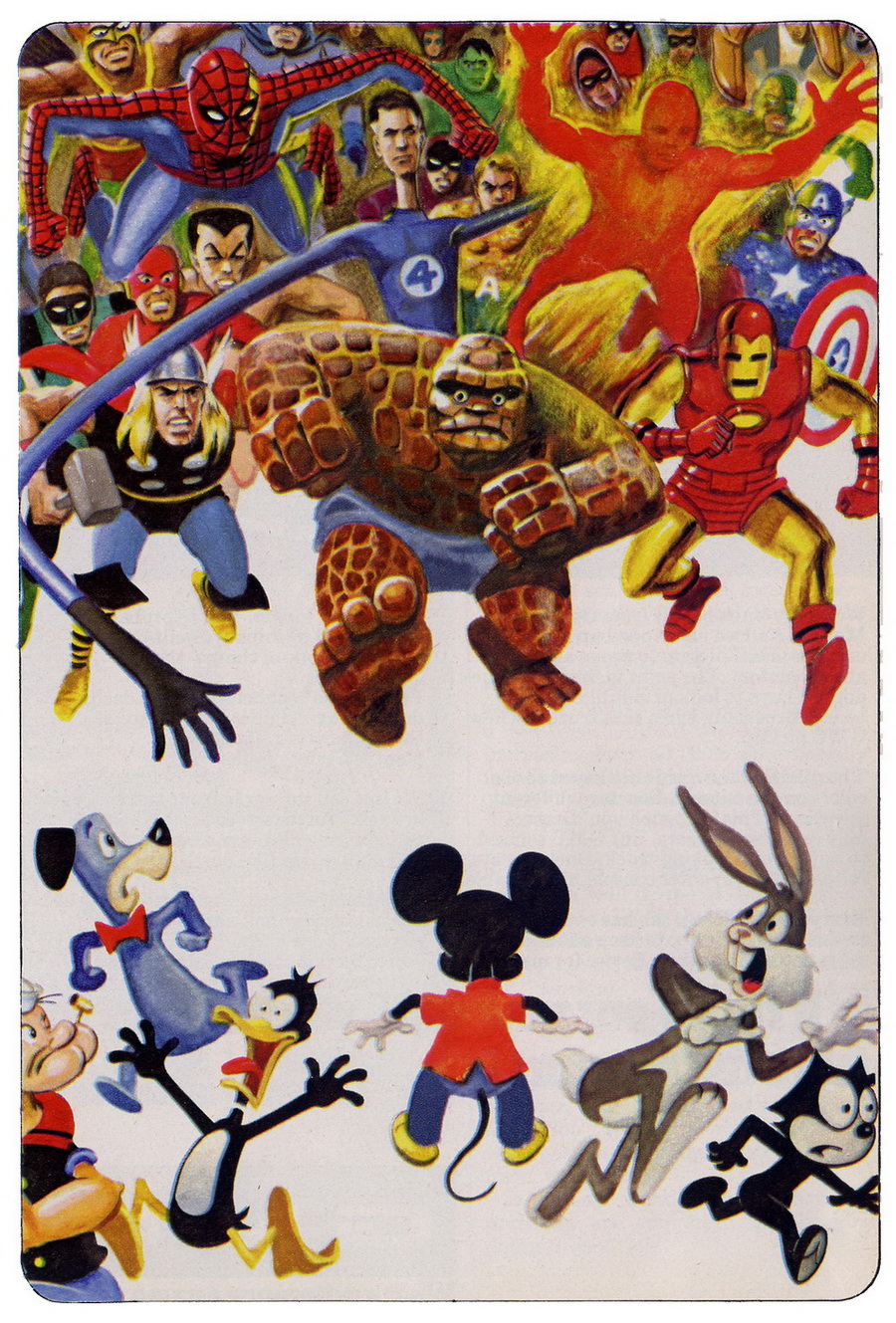
So here's what I'm thinking. You're born, early infancy, what do you watch? Disney movies. And then you grow a bit, look for a little more edge, a little more maturity, and you find Marvel (at least I did). You kind of leave Disney behind except for fond memories, and still thinking Lion King is bad-ass and humming Hakuna Matata while you write :P
But now Disney stands poised to obtain Marvel. Disney's shares are worse off than Marvel, and from all the products floating around, I get the sense the crisis isn't exactly killing the comic giant. So I'd assume that if Disney has any sense, they won't look to change a thing, rather the opposite, give Marvel more resources to, like Wolverine, be the best at what they do.
And this means Disney now has an even bigger monster of a brand (if that was even possible). If this goes through, Disney can be the over-arching name responsible for so many elements of your imagination from the day you're born to the day you die as an overgrown kid who still gets excited at the thought of super-heroes. The full range - from flowery happy Bambi and Mermaid to dark discussions of humanity like Marvel Civil War and Earth X. It's a one-stop shop of awesome, just shift to the next age slot as you grow and Disney's got you set.
I don't think it's too bad - very influenced by the crisis I think though. But it's not like I'm hoping for Lucasarts to join the club now or anything, just to complete the set. The standard concerns are of course present: is this going to kill the Marvel spirit? Will they be watered down? Will vision be lost in too many layers of hierarchy? Will we begin to see cross-overs? Will Mickey don a crime fighting mask? Will we get a Kingdom Hearts: Marvel Avengers? (Sora, Hercules, Sephiroth and Cap in one game?)
Let's see how this goes... Here's to you Mickey, Spidey. Make friends, play nice. Stay out of each other's backyard and be good neighbors.
P.S. I know the image above isn't all Marvel vs Disney, but gimme a break, it's a great fit right?
"Entertainment giant Walt Disney is to buy Marvel Entertainment in a shares and cash deal valued at $4bn (£2.5bn).
The deal means Disney will take over ownership of 5,000 Marvel characters, such as Spider-Man and the X-Men. Marvel shareholders will get $30 per share in cash plus 0.745 Disney shares for every Marvel share owned.
The boards of Disney and Marvel have both approved the deal, which now needs the backing of Marvel shareholders and competition authorities."
Hi guys! Thanks for inviting us to the party... don't run, we brought hugs!
So here's what I'm thinking. You're born, early infancy, what do you watch? Disney movies. And then you grow a bit, look for a little more edge, a little more maturity, and you find Marvel (at least I did). You kind of leave Disney behind except for fond memories, and still thinking Lion King is bad-ass and humming Hakuna Matata while you write :P
But now Disney stands poised to obtain Marvel. Disney's shares are worse off than Marvel, and from all the products floating around, I get the sense the crisis isn't exactly killing the comic giant. So I'd assume that if Disney has any sense, they won't look to change a thing, rather the opposite, give Marvel more resources to, like Wolverine, be the best at what they do.
And this means Disney now has an even bigger monster of a brand (if that was even possible). If this goes through, Disney can be the over-arching name responsible for so many elements of your imagination from the day you're born to the day you die as an overgrown kid who still gets excited at the thought of super-heroes. The full range - from flowery happy Bambi and Mermaid to dark discussions of humanity like Marvel Civil War and Earth X. It's a one-stop shop of awesome, just shift to the next age slot as you grow and Disney's got you set.
I don't think it's too bad - very influenced by the crisis I think though. But it's not like I'm hoping for Lucasarts to join the club now or anything, just to complete the set. The standard concerns are of course present: is this going to kill the Marvel spirit? Will they be watered down? Will vision be lost in too many layers of hierarchy? Will we begin to see cross-overs? Will Mickey don a crime fighting mask? Will we get a Kingdom Hearts: Marvel Avengers? (Sora, Hercules, Sephiroth and Cap in one game?)
Let's see how this goes... Here's to you Mickey, Spidey. Make friends, play nice. Stay out of each other's backyard and be good neighbors.
P.S. I know the image above isn't all Marvel vs Disney, but gimme a break, it's a great fit right?
My Darling Jumping - Trigger and Environmental Feedback Loop Mechanics
This article discusses a certain type of mechanics, which I playfully call trigger-Whoa, where players trigger an action and then interact with autonomous systems in the environment, providing an unpredictable, emergent and watchable experience. This is responsible for some of my most cherished memories as a gamer, and is one of the fields gameplay designers should seek to develop.
.::.---.::.
I've always loved jumping in games, falling and adjusting my landing to make it. Or swinging in the good Spider-Man games (2, Ultimate, Web of Shadows). Or drifting in Outrun. Crashing in Burnout. The list goes on. I've sat and considered the common feeling I get when playing these games. In my mind, I call it Fshhhhh, could also be described as a trigger-Whoa feeling.

Essentially, the common element in all these mechanics is that they are triggered directly by the player who decides when to jump, swing, brake, explode, etc. But then something else happens. It's not a scripted event - the player is thrown into a potentially lengthy period where they can only control their avatar indirectly, as it is being affected by some element of the environment (often a physics model).
Back in the day, it wasn't that easy to have autonomous systems beyond your direct character control - processing power was limited, spent on enemies (direct challenges), objectives (tokens) and such. Having a fall pull you down in the Y axis faster than you can adjust the X already made for fun jumping in Mario.
Contemporary game jumps can be affected by complex physics, and calculate for friction, wind, etc. Even a tiny little game on the iPhone, Mr. Aahh!!, pulls this off well: all you do is tap the screen to release your character as he swings in order to land in the center of a platform with variable width. Land, he runs and swings again. Straight up arcade gameplay, getting more challenging with each swing. As far as I've played, wind and gravity come into play, and you can adjust the fall slightly by tilting the device. Great fun, and gets hard quickly. Made it to H-2 first time if I'm not mistaken. :)
Now, with little effort, we can incorporate solid autonomous systems like physics and world AI, and the result can be far more engaging, emergent and unpredictable. It can make for solid gameplay with incredible replay value. Take something like 'Splosion Man, where all you do is 'splode (sorry, couldn't help myself). By blowing yourself up, you're launched with a a simple physics engine, and can steer or explode again (up to 3 times). But if you factor in up to 4 co-op players, exploding barrels, the ability to regain explosion power by sliding down walls ... That's a lot of flying, and collective "Whoaaaa is he gonna make it???" moments. I think this is also why Peggle is so madly successful and addictive - you launch that little ball and watch it bounce around the pegs with a pretty decent little physics model. If you've ever played Peggle with a few people watching, you know they'll draw their breaths in tense expectation, eyes tracking the ball's every movement, letting out a collective cheer when you hit that middle slot and the Ode to Joy (inspired sound design!) plays.
These games have the potential vast replayability since, like in real life, minute adjustments to these trigger activities can cause dramatically different outcomes.They are also immensely watchable, since people can intuitively understand the actions and all share a tension, us vs. the game world, if you will, once the initial trigger is activated. Will he hit that target vehicle with this lucky collision in Burnout crash mode? Can he slingshot round the skyscraper fast enough to catch that other building in Spider-man?
And then we've all had our laughs with emergence, from rag-dolls in ridiculous positions and glitchy spasms, to idiot AI staring at the wall one minute and beating on a team-mate the next. I think you can certainly say there are plenty of these trigger-Whoa moments in games with great sandbox AI like GTA, Bioshock - throwing in that one little grenade or shot and watching all hell break loose, often caught between explosions and enemies in the chaos you started. That's a little higher level, on a complex dynamic rather than mechanic level, but it still shares that core of activating and watching what unpredictability happens next, while trying to adjust your response.
I know that sometimes developers are tempted to take the easy way out - script/animate 2 or 3 jumps, for example, and make them bad-ass and cycle randomly when you jump, rather than worry about a full physics rig that can flap about in crazy, unpredictable and goofy ways. But while there can certainly be the case for cinematic, well put together sequences, I tend to prefer these in games like Fahrenheit (Indigo Prophecy), where you don't expect or need to be given full physical control, just the ability to guide. If I'm playing an action game, I don't even much enjoy stylish, cinematic kills (for example) unless there's some kind of contextual control at least (not quick-time events), like in Assassin's Creed or Fable II.
The thing is, I see cinematic solutions as a crutch more often than not, flash added to stale mechanics, instead of a genuine exploration in new ways of doing things. I love that we're getting technology like Euphoria, which helps us get closer to the best of both worlds. Splicing in those bad-ass diving poses while falling in a rag-doll that protects its head is now possible, and this should ring a bell in gameplay designer's minds.
I think we as developers have no excuse not to keep driving the experience forward, and evolving the art. As a designer, I'm principally concerned with gameplay and feel, and think that if you succeed in establishing that feeling of suspense and drawn breath, adding the visual flair on top of it is a simple affair.
I'm only talking about a certain kind of experience, and not proclaiming it the only one, far from me. I love my beautifully blended, non-physics enabled animations in Dead or Alive, for example, and constantly appreciate how well they give me more back as soon as I learn to control them better. I need to play Flower on the PSN again, but in my memory it did a great job at simulating environmental feedback when there was none with the sound design and visual effects, like the blurring while moving faster or parting of blades of grass.
But I will say this, some of the most memorable mechanics for me are the ones that brought out this feeling, and it is very often to those games I will return after years and years, just for another jump, another run, another little joyride, 20 minutes of fluid, dynamic and flowing gameplay. I still remember how crazy and fun it was to ride those waves in Wave Race 64 and go flying on the larger ones, hoping to make the landing within bounds. In fact, I think I've made my point, and will go do a little racing now.
Take care, and happy jumping!
.::.---.::.
I've always loved jumping in games, falling and adjusting my landing to make it. Or swinging in the good Spider-Man games (2, Ultimate, Web of Shadows). Or drifting in Outrun. Crashing in Burnout. The list goes on. I've sat and considered the common feeling I get when playing these games. In my mind, I call it Fshhhhh, could also be described as a trigger-Whoa feeling.
Crackdown jumping is epic. [Img Source]
Essentially, the common element in all these mechanics is that they are triggered directly by the player who decides when to jump, swing, brake, explode, etc. But then something else happens. It's not a scripted event - the player is thrown into a potentially lengthy period where they can only control their avatar indirectly, as it is being affected by some element of the environment (often a physics model).
Back in the day, it wasn't that easy to have autonomous systems beyond your direct character control - processing power was limited, spent on enemies (direct challenges), objectives (tokens) and such. Having a fall pull you down in the Y axis faster than you can adjust the X already made for fun jumping in Mario.
Contemporary game jumps can be affected by complex physics, and calculate for friction, wind, etc. Even a tiny little game on the iPhone, Mr. Aahh!!, pulls this off well: all you do is tap the screen to release your character as he swings in order to land in the center of a platform with variable width. Land, he runs and swings again. Straight up arcade gameplay, getting more challenging with each swing. As far as I've played, wind and gravity come into play, and you can adjust the fall slightly by tilting the device. Great fun, and gets hard quickly. Made it to H-2 first time if I'm not mistaken. :)
Now, with little effort, we can incorporate solid autonomous systems like physics and world AI, and the result can be far more engaging, emergent and unpredictable. It can make for solid gameplay with incredible replay value. Take something like 'Splosion Man, where all you do is 'splode (sorry, couldn't help myself). By blowing yourself up, you're launched with a a simple physics engine, and can steer or explode again (up to 3 times). But if you factor in up to 4 co-op players, exploding barrels, the ability to regain explosion power by sliding down walls ... That's a lot of flying, and collective "Whoaaaa is he gonna make it???" moments. I think this is also why Peggle is so madly successful and addictive - you launch that little ball and watch it bounce around the pegs with a pretty decent little physics model. If you've ever played Peggle with a few people watching, you know they'll draw their breaths in tense expectation, eyes tracking the ball's every movement, letting out a collective cheer when you hit that middle slot and the Ode to Joy (inspired sound design!) plays.
These games have the potential vast replayability since, like in real life, minute adjustments to these trigger activities can cause dramatically different outcomes.They are also immensely watchable, since people can intuitively understand the actions and all share a tension, us vs. the game world, if you will, once the initial trigger is activated. Will he hit that target vehicle with this lucky collision in Burnout crash mode? Can he slingshot round the skyscraper fast enough to catch that other building in Spider-man?
And then we've all had our laughs with emergence, from rag-dolls in ridiculous positions and glitchy spasms, to idiot AI staring at the wall one minute and beating on a team-mate the next. I think you can certainly say there are plenty of these trigger-Whoa moments in games with great sandbox AI like GTA, Bioshock - throwing in that one little grenade or shot and watching all hell break loose, often caught between explosions and enemies in the chaos you started. That's a little higher level, on a complex dynamic rather than mechanic level, but it still shares that core of activating and watching what unpredictability happens next, while trying to adjust your response.
I know that sometimes developers are tempted to take the easy way out - script/animate 2 or 3 jumps, for example, and make them bad-ass and cycle randomly when you jump, rather than worry about a full physics rig that can flap about in crazy, unpredictable and goofy ways. But while there can certainly be the case for cinematic, well put together sequences, I tend to prefer these in games like Fahrenheit (Indigo Prophecy), where you don't expect or need to be given full physical control, just the ability to guide. If I'm playing an action game, I don't even much enjoy stylish, cinematic kills (for example) unless there's some kind of contextual control at least (not quick-time events), like in Assassin's Creed or Fable II.
The thing is, I see cinematic solutions as a crutch more often than not, flash added to stale mechanics, instead of a genuine exploration in new ways of doing things. I love that we're getting technology like Euphoria, which helps us get closer to the best of both worlds. Splicing in those bad-ass diving poses while falling in a rag-doll that protects its head is now possible, and this should ring a bell in gameplay designer's minds.
I think we as developers have no excuse not to keep driving the experience forward, and evolving the art. As a designer, I'm principally concerned with gameplay and feel, and think that if you succeed in establishing that feeling of suspense and drawn breath, adding the visual flair on top of it is a simple affair.
I'm only talking about a certain kind of experience, and not proclaiming it the only one, far from me. I love my beautifully blended, non-physics enabled animations in Dead or Alive, for example, and constantly appreciate how well they give me more back as soon as I learn to control them better. I need to play Flower on the PSN again, but in my memory it did a great job at simulating environmental feedback when there was none with the sound design and visual effects, like the blurring while moving faster or parting of blades of grass.
But I will say this, some of the most memorable mechanics for me are the ones that brought out this feeling, and it is very often to those games I will return after years and years, just for another jump, another run, another little joyride, 20 minutes of fluid, dynamic and flowing gameplay. I still remember how crazy and fun it was to ride those waves in Wave Race 64 and go flying on the larger ones, hoping to make the landing within bounds. In fact, I think I've made my point, and will go do a little racing now.
Take care, and happy jumping!
Subscribe to:
Posts (Atom)
